A comprehensive database developed by the OWI-Lab (Offshore Wind Infrastructure Lab). The central repository for metadata related to offshore wind energy research, monitoring, and infrastructure. Supporting researchers, engineers, and industry professionals with a homogenized interface to access technical information about offshore wind energy assets.
The OWI-Metadatabase is particularly valuable for facilitating collaboration, ensuring data transparency, and accelerating innovation in the offshore wind sector. It aligns with the broader goals of OWI-Lab to advance sustainable energy solutions through data-driven research.
Explore the modules of our application, each built around a specific theme
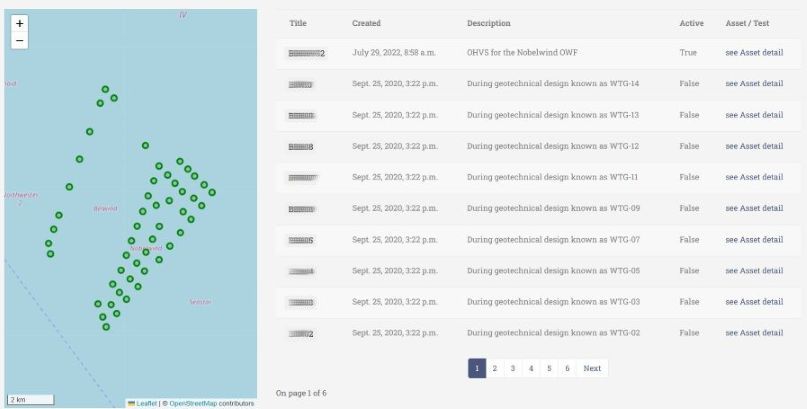
Comprehensive location management system for offshore wind entities. Track and manage geographical data and related information for assets across projects.
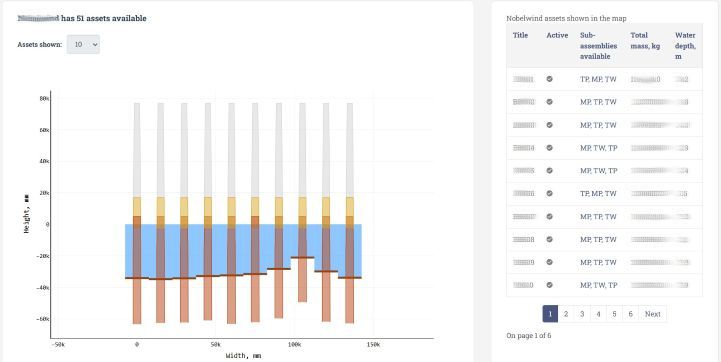
Advanced system for managing geometrical data related to offshore wind structures. Ensures accurate representation of physical assets to support your design and analysis workflows.
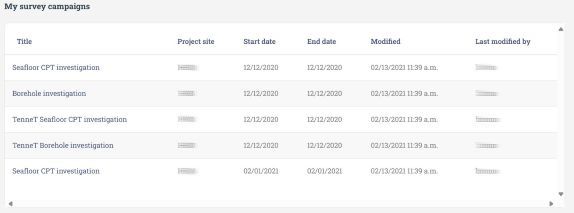
Store and analyze geotechnical data for offshore foundations to support your engineering decisions. Contains public geotechnical data from RVO (The Netherlands), BSH (Germany) and FOD Economy (Belgium).
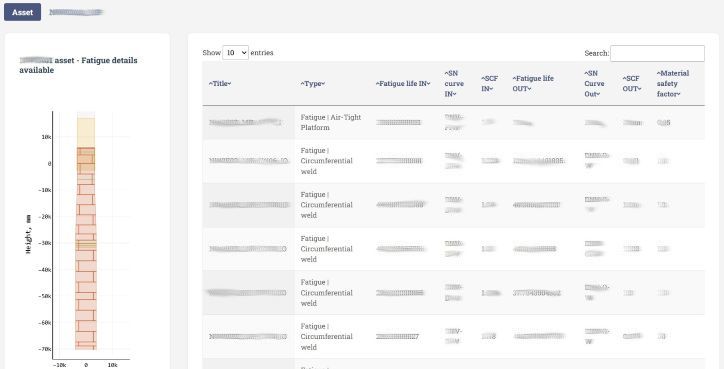
Store, analyze and visualize fatigue data from offshore installations. Track key design and inspection data, such as SN-curves and fatigue life predictions as well as as-built information and defects. Vital input in any future lifetime extension or O&M optimization.
Publicly accessible resources to work with OWI-Metadatabase
An open-source Python package to work with data from the OWI-Metadatabase. It is the recommended way to retrieve the data for users. Includes various methods to get, perform (advanced) processing, and visualize data from the OWI-Metadatabase.
View on GitHubResearch output using OWI-Metadatabase
Open-source Python package to retrieve data from OWI-Metadatabase.
This dataset combines shear wave velocity measurements and associated CPT for offshore wind farm sites in The Netherlands and Germany. The data has been collected by RVO in The Netherlands and BSH in Germany and is available in the public domain. The author has processed the data as part of his PhD research at Vrije Universiteit Brussel.
Model-based virtual sensing offers a viable approach for monitoring fatigue loads on operational offshore wind turbines. These methods combine response measurements with first-principle, or data-informed models, to estimate load time series at hard-to-access locations. However, their accuracy depends on the fidelity of the underlying model, which is largely influenced by uncertainties in the soil–structure interaction (SSI) models. This study evaluates the impact of different SSI modelling approaches in terms of a virtual sensing validation study targeting strain estimation above and below the mudline of a bottom-founded offshore wind turbine. To this end, different numerical models derived from, and validated against, design documentation serve as input to a dual-band modal decomposition and expansion (MDE) method. The considered SSI models range from an API/DNV-based foundation model to a PISA-based model including scour protection. Virtual sensing results are generated for two-year equivalent datasets, obtained for three operational offshore wind turbines, each equipped with extensive load monitoring systems. One turbine is used to assess the effect of the model updates, while two additional turbines are used to assess the across-site consistency. The estimated strains are directly compared against available strain validation data, in terms of damage-equivalent stress, and are accumulated to give a single comparative metric representative for the two-year periods. Results show that PISA-based soil reaction curves significantly improve agreement with measured strains while adding a scour protection model has a relatively smaller impact. These findings highlight the importance of accurate foundation modelling in virtual sensing and demonstrate the feasibility of fatigue monitoring at hard-to-access locations.
The Willow project has received funding from the European Union's Horizon Europe research and innovation programme under grant agreement 1011122184.
Views and opinions expressed are however those of the author(s) only and do not necessarily reflect those of the European Union or European Commission. Neither the European Union nor the granting authority can be held responsible for them.